

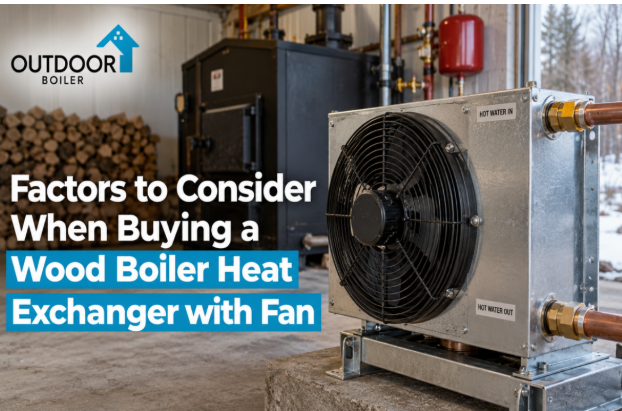
If you are comparing a wood boiler heat exchanger with a fan, focus on more than price or appearance. I would look closely at sizing, materials, airflow, safety, installation needs, and how easily the unit can be maintained over time.
Understand what the heat exchanger does
A wood boiler heats water, or sometimes a water and antifreeze mixture, which then travels through pipes to a heat exchanger. The exchanger transfers that heat into air, and the fan moves the warmed air through a duct, room, workshop, greenhouse, or other space. In simple terms, the boiler creates the heat, the exchanger transfers it, and the fan distributes it.
This setup can be useful when you want to connect a wood boiler to an existing forced-air system. It can also be used as a standalone air heating unit in a garage or outbuilding. Understanding this process helps you compare products more intelligently because the exchanger must match both the boiler and the air delivery system.
1. Choose the right heating capacity
The first factor is output. A heat exchanger that is too small may run constantly without warming the space properly. One that is too large can create unnecessary cycling, uneven temperatures, and wasted energy. Look for the manufacturer’s rated water temperature, air temperature rise, airflow range, and heat output.
Do not choose capacity by guessing from the building’s floor area alone. Insulation, ceiling height, windows, climate, duct length, and air leakage all affect the actual heating load. A qualified heating professional can calculate the requirement more accurately. If the exchanger will connect to an existing furnace, compare its airflow requirements with the furnace blower and ductwork.
2. Check airflow and fan performance
The fan is just as important as the exchanger coil. Review its airflow rating, measured in cubic feet per minute, along with static pressure performance. A fan may move a large volume of air in an open test, but its performance can drop when air must pass through filters, bends, registers, and long ducts.
Also consider noise. A powerful fan may distribute heat quickly but become distracting in a living area. Variable speed control can provide quieter operation and more even temperatures. Ask whether the motor is designed for continuous use and whether replacement parts are readily available.
3. Inspect materials and construction
The coil and cabinet must handle heat, moisture, and repeated temperature changes. Copper and aluminum are common choices, while stainless steel may be selected for areas where corrosion resistance is especially important. The best material depends on the water quality, fluid type, operating temperature, and maintenance routine.
Look for solid connections, a durable cabinet, accessible service panels, and insulation around the air chamber where appropriate. Ask the supplier what water chemistry is recommended and whether the unit requires treated water or antifreeze. A well-built exchanger should have clear specifications rather than vague claims about performance.
4. Match the exchanger to the boiler system
Compatibility is essential. Confirm the exchanger’s maximum pressure and temperature ratings, connection size, flow requirements, and recommended pump capacity. The boiler, pump, piping, controls, and exchanger must work as one system.
If the water flow is too low, the exchanger may not transfer enough heat. If it is too high, the pump may use more electricity and create unnecessary noise. You should also confirm whether the system needs a mixing valve, expansion tank, air separator, check valve, or freeze protection. These details are not exciting, but they can prevent expensive problems later.
5. Prioritize safety features
A wood heating system should never be treated like a simple plug-in appliance. Ask about high temperature limits, fan controls, pressure relief protection, automatic shutdown features, and safe placement. The installation should follow local building, plumbing, electrical, and fire requirements.
The U.S. Environmental Protection Agency explains that hydronic heaters transfer heat through water or a water and antifreeze solution, and it advises buyers to check state and local rules. Requirements can vary significantly, especially for outdoor wood boilers and emissions. Read the EPA guidance before buying and consult local authorities when necessary.
6. Consider efficiency and heat storage
The exchanger itself is only one part of overall efficiency. Heat can be lost through poorly insulated pipes, ducts, fittings, and storage tanks. Insulation and thoughtful pipe routing may improve useful heat delivery more than choosing a slightly larger exchanger.
Heat storage can also affect boiler performance. New York State Department of Health notes that insulated storage tanks allow some wood boilers to burn fuel hot and fast, then provide stored heat as needed. This can be especially useful with gasification boilers, which generally work best with dry wood and consistent high-temperature operation.
7. Think about maintenance access
Dust, ash, insects, and debris can reduce airflow and heat transfer. Choose a design that allows you to clean the air side, inspect the coil, replace filters, and service the fan without dismantling the entire system. Ask how often the manufacturer recommends cleaning and whether replacement motors, belts, controls, and sensors are available.
A clear warranty is helpful, but service support matters just as much. Before buying, find out who handles technical questions and whether the parts can be obtained locally or shipped quickly.
8. Review installation and operating costs
The purchase price is only the beginning. Include the cost of pumps, controls, duct changes, electrical work, insulated pipe, chimney or venting requirements, storage, water treatment, and professional installation. Also estimate fuel preparation, maintenance, electricity for pumps and fans, and possible repairs.
New York State warns that some outdoor wood boilers can produce significant smoke and use more fuel than higher-efficiency gasification units. That is a useful reminder to consider the complete system, not just the heat exchanger’s advertised output. Dry fuel, correct operation, and suitable equipment all influence real-world results.
Make a careful decision
The right wood boiler heat exchanger with fan should match your building, boiler, ductwork, climate, and comfort goals. Compare verified specifications, ask practical installation questions, and confirm local requirements before placing an order. A little research at the beginning can help you avoid poor airflow, safety concerns, and avoidable operating costs.
For more practical guidance on heating equipment, system planning, and maintenance, visit outdoorboiler.com and explore our latest informational resources.